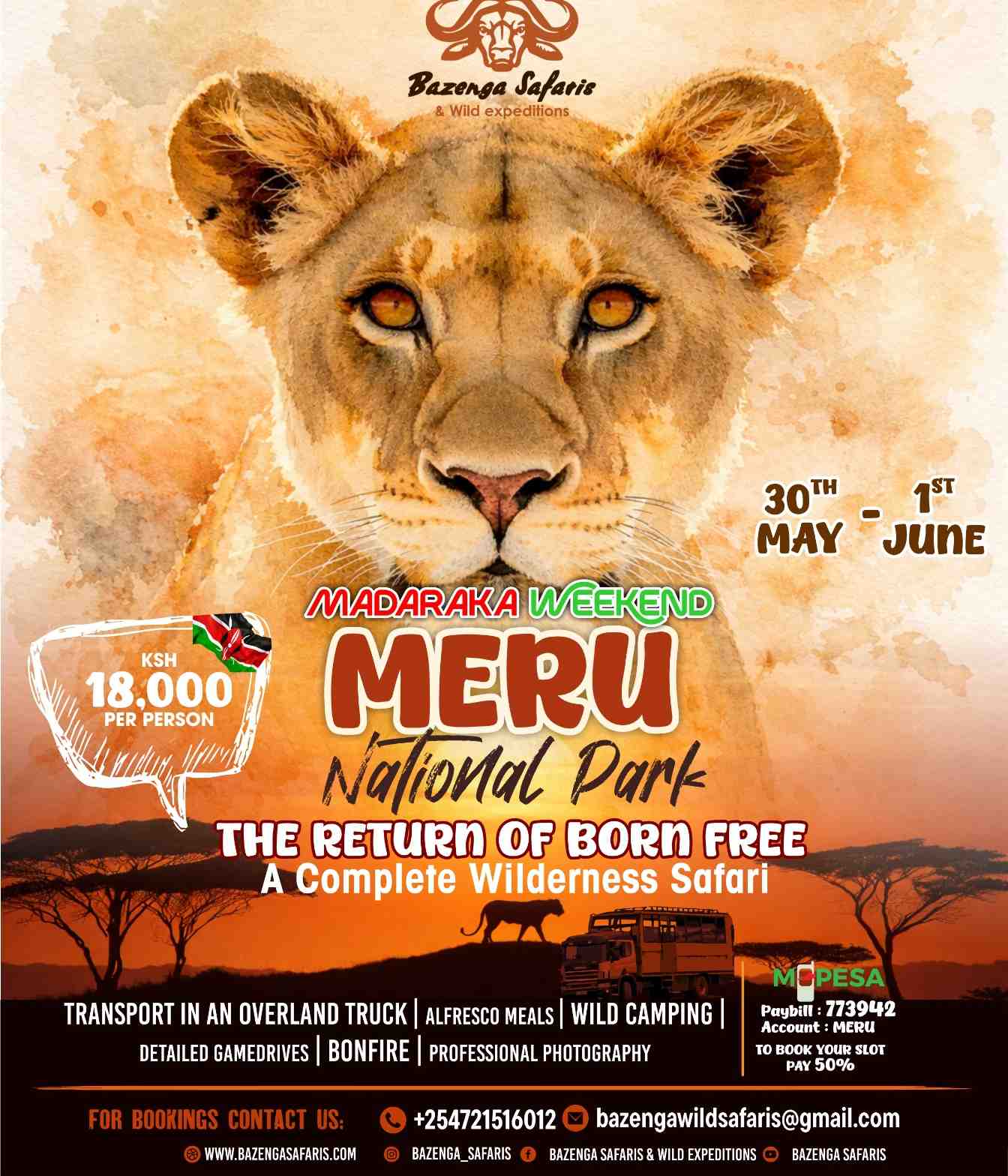
Meru National Park Safari Guide 2026
29 May, 2026
Kenya's Last Wild Frontier
Wildlife, Overlanding & Hidden Gems
Thirteen permanent rivers cut through this park. Black and white rhinos share the same protected ground here, and the story of Born Free still shapes how people talk about it. Compared to Kenya's more visited parks, Meru National Park gets overlooked, but it might be one of the country's most rewarding safari destinations.
Wildlife lovers, photographers, birders, and people who just want to disappear into the bush for a few days will all find something here.
Why Visit Meru National Park?
Ask most people to name a Kenya safari destination and you'll hear Maasai Mara, Amboseli, Tsavo, Samburu. Meru rarely makes the list, which is exactly why people who've been there tend to bring it up first.
Meru sits about 350 kilometers northeast of Nairobi and covers roughly 870 square kilometers of open savannah, dense acacia woodland, riverine forest, swamp, and rocky outcrops, fed by more than thirteen permanent rivers flowing down from the Nyambene Hills.
In busier parks, animals get used to vehicles and barely react to them. That's not the case in Meru. Wildlife here behaves the way it would without an audience, and it's common to drive for hours without seeing another safari vehicle.
If what you want is space, quiet, and animals that haven't learned to ignore you, Meru delivers that better than almost anywhere else in Kenya.
A Landscape Shaped by Water
Water defines Meru.
Much of northern Kenya spends long stretches of the year dry, but Meru's thirteen permanent rivers keep the ecosystem here alive year-round.
The Rojewero, the Ura, the Tana, and a scatter of smaller tributaries feed the riverine forests where elephants, hippos, crocodiles, leopards, and buffalo live alongside hundreds of bird species.
The terrain shifts as you move through the park. The north is thick with woodland and elephant grass. Head further in and it opens into classic savannah, dotted with baobabs and doum palms. During the dry season, wetlands like Mulika Swamp pull in wildlife from all directions as smaller water sources disappear.
That range of habitat, packed into one park, is a big part of why the wildlife here is so varied.
The Born Free Legacy
Few parks anywhere carry a conservation story like Meru's.
George and Joy Adamson raised Elsa the lioness here and then did something almost nobody had tried before: they returned her to the wild instead of keeping her in captivity. That story became the book and film Born Free, and it changed how a lot of people thought about wildlife conservation.
Elsa's grave still sits along the Ura River, where she was buried after she died in 1961.
Joy Adamson later did similar rehabilitation work with a cheetah named Pippa, also within the park. Between the two projects, Meru has a genuine claim to being one of the more important sites in the history of African wildlife conservation.
Walking through the park, you're not just on a game drive. You're standing where a lot of that history actually happened.
Wildlife in Meru National Park
Meru holds one of Kenya's richest wildlife populations.
Anti-poaching work by the Kenya Wildlife Service has helped numbers recover substantially over the past few decades. Visitors regularly see:
● African elephants
● African lions
● Leopards
● Cheetahs
● African buffalo
● Masai giraffes
● Plains zebras
● Hippos
● Nile crocodiles
● Hyenas
● Warthogs
● Waterbucks
● Impalas
● Bushbucks
● Olive baboons
● Vervet monkeys
The park also protects several species you won't easily find on Kenya's more common safari routes.
Meru's Rhino Sanctuary
Meru's 84-square-kilometer Rhino Sanctuary is one of its biggest draws, and one of the only places in East Africa where you can see black rhino (Diceros bicornis) and white rhino (Ceratotherium simum) in the same protected area.
Black rhinos browse in dense acacia thicket. White rhinos graze open grassland. Spotting both in a single safari isn't something you can count on in most parks.
The sanctuary is one of the Kenya Wildlife Service's clearer conservation successes, and it's still doing active work protecting these animals.
Northern Kenya's Special Wildlife
Meru also protects a handful of northern species that most safari-goers never encounter.
Grevy's Zebra
The largest and most endangered zebra species in the world. Narrower stripes than the common zebra, a white belly, and unusually large, rounded ears.
Gerenuk
Sometimes called the giraffe gazelle. It stands on its hind legs to browse leaves other antelope can't reach.
Beisa Oryx
A desert-adapted antelope with long, straight horns and a body built to handle heat most animals can't.
Somali Ostrich
Bigger than the common ostrich. During breeding season, the males' necks and legs turn a striking blue-gray.
For photographers or anyone who's already ticked off the usual safari animals, these four alone are worth the detour.
Birdwatching
Over 500 bird species have been recorded in Meru, which puts it among Kenya's best birding destinations.
Look for African Fish Eagles, Martial Eagles, Secretary Birds, kingfishers, bee-eaters, hornbills, herons, storks, African Skimmers, and Peter's Finfoot, among others. Between the rivers, wetlands, forest, and grassland, the habitat here supports both resident birds and migratory ones passing through.
The Greater Meru Ecosystem
Meru National Park is only part of a much larger protected area, more than 3,200 square kilometers when you include Bisanadi National Reserve, Kora National Park, and Mwingi National Reserve.
Wildlife moves between these areas along corridors that have existed for a very long time, which is part of why elephant and predator populations across the region have stayed relatively healthy.
Overlanding in Meru
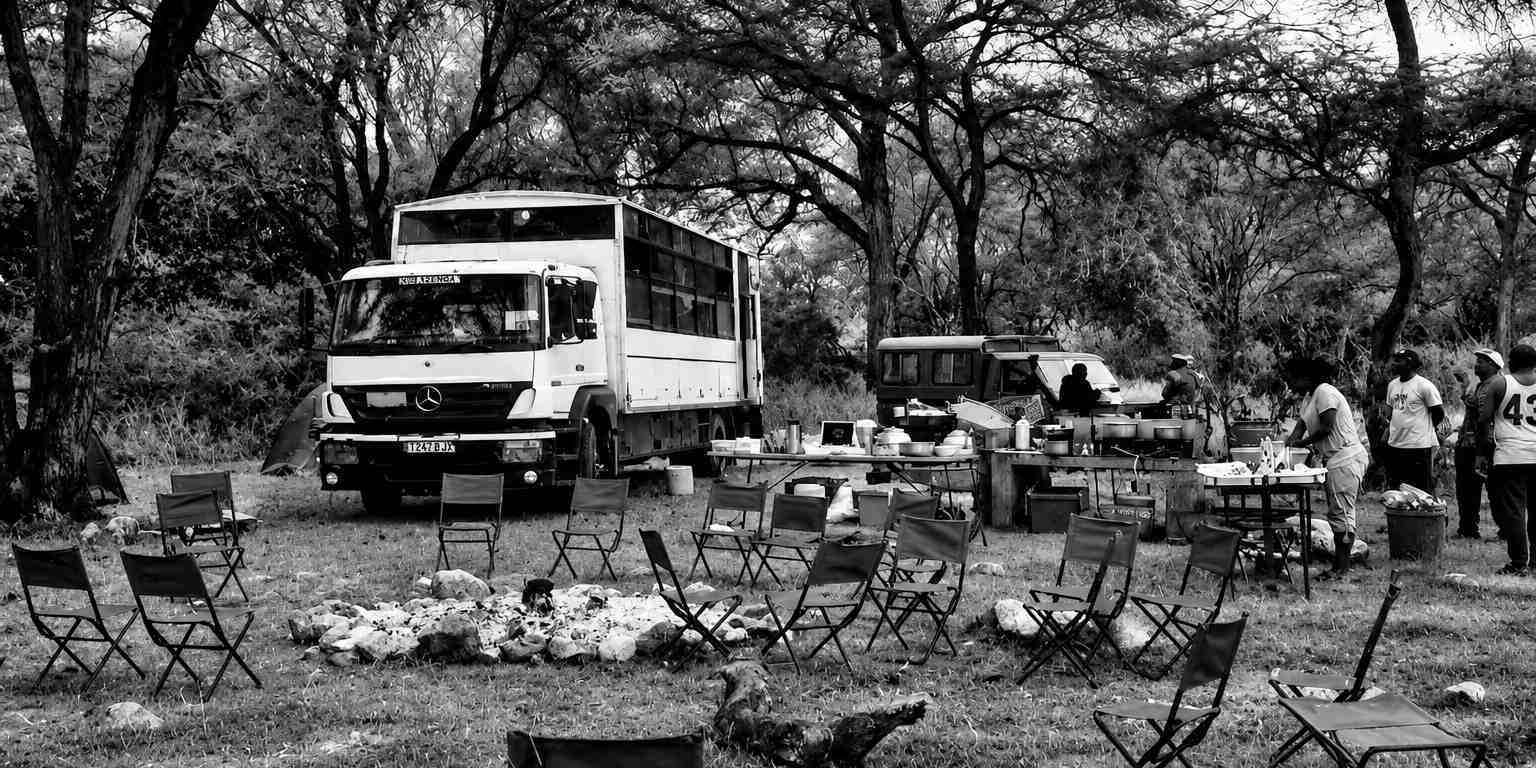
Meru is one of the better overlanding destinations in Kenya. The terrain doesn't make it easy: rough tracks, remote campsites, and river crossings that depend on the season.
Overland trips here typically run in fully equipped 4x4s built to handle mud, rock, and water crossings, along with the remote camping that comes with the territory. If you want a safari that feels more like an expedition, this is closer to that than most parks offer.
Bush Camping
Camping in Meru is its own experience. There's very little light pollution, so the stars are genuinely bright, and the Milky Way is visible on clear nights.
At night you'll hear lions, hippos grunting nearby, hyenas calling, insects, and elephants moving through the dark somewhere you can't quite see. It's not a curated soundscape. It's just what the bush sounds like after dark, and it tends to stick with people long after the trip ends.
Best Time to Visit
January to March and July to October are the two dry windows, and they're generally the easier months to visit: better roads, easier game viewing, more comfortable camping, and good conditions for photography.
The rainy months turn the park green and bring in a wider range of migratory birds, so if birding matters more to you than easy roads, it's worth considering.
Getting There
Meru is about 350 kilometers from Nairobi, roughly a five-hour drive through Embu and Meru Town. You can also fly into Mulika Airstrip on a scheduled or charter flight.
Most guided safari packages bundle transport, park fees, accommodation, guides, and game drives into one price.
Accommodation
Options range from luxury lodges and boutique tented camps to Kenya Wildlife Service campsites, mobile expedition camps, and standard overland camping. Whatever your budget or comfort level, there's a way to stay inside the park.
Conservation
Park entry fees go directly toward the things keeping Meru intact: rhino protection, anti-poaching patrols, habitat restoration, research, wildlife monitoring, and community conservation work. Visiting the park is, in a small but real way, part of funding that work.
Why Bazenga Safaris & Wild Expeditions
We try to build safaris around more than just wildlife sightings, though there's plenty of that too. Our Meru trips include professional guides, 4x4 vehicles built for the terrain, custom itineraries, and a mix of camping and lodge options depending on what you're after: family trips, private expeditions, or small group adventures.
If you haven't been to Kenya before, or you're coming back looking for something outside the usual circuit, we can put together a Meru safari around what you actually want to see.
Kenya's Last Wild Frontier
Meru doesn't get the traffic that Maasai Mara or Amboseli do, and that's most of the point. The wildlife is genuinely wild, the conservation history is real and still visible on the ground, and the landscape does most of the work without needing to be dressed up.
If that sounds like the kind of safari you want, Meru is worth putting near the top of the list.
Twende Meru Kibazenga.
Let Bazenga Safaris & Wild Expeditions get you there.
Wildlife, Overlanding & Hidden Gems
Thirteen permanent rivers cut through this park. Black and white rhinos share the same protected ground here, and the story of Born Free still shapes how people talk about it. Compared to Kenya's more visited parks, Meru National Park gets overlooked, but it might be one of the country's most rewarding safari destinations.
Wildlife lovers, photographers, birders, and people who just want to disappear into the bush for a few days will all find something here.
Why Visit Meru National Park?
Ask most people to name a Kenya safari destination and you'll hear Maasai Mara, Amboseli, Tsavo, Samburu. Meru rarely makes the list, which is exactly why people who've been there tend to bring it up first.
Meru sits about 350 kilometers northeast of Nairobi and covers roughly 870 square kilometers of open savannah, dense acacia woodland, riverine forest, swamp, and rocky outcrops, fed by more than thirteen permanent rivers flowing down from the Nyambene Hills.
In busier parks, animals get used to vehicles and barely react to them. That's not the case in Meru. Wildlife here behaves the way it would without an audience, and it's common to drive for hours without seeing another safari vehicle.
If what you want is space, quiet, and animals that haven't learned to ignore you, Meru delivers that better than almost anywhere else in Kenya.
A Landscape Shaped by Water
Water defines Meru.
Much of northern Kenya spends long stretches of the year dry, but Meru's thirteen permanent rivers keep the ecosystem here alive year-round.
The Rojewero, the Ura, the Tana, and a scatter of smaller tributaries feed the riverine forests where elephants, hippos, crocodiles, leopards, and buffalo live alongside hundreds of bird species.
The terrain shifts as you move through the park. The north is thick with woodland and elephant grass. Head further in and it opens into classic savannah, dotted with baobabs and doum palms. During the dry season, wetlands like Mulika Swamp pull in wildlife from all directions as smaller water sources disappear.
That range of habitat, packed into one park, is a big part of why the wildlife here is so varied.
The Born Free Legacy
Few parks anywhere carry a conservation story like Meru's.
George and Joy Adamson raised Elsa the lioness here and then did something almost nobody had tried before: they returned her to the wild instead of keeping her in captivity. That story became the book and film Born Free, and it changed how a lot of people thought about wildlife conservation.
Elsa's grave still sits along the Ura River, where she was buried after she died in 1961.
Joy Adamson later did similar rehabilitation work with a cheetah named Pippa, also within the park. Between the two projects, Meru has a genuine claim to being one of the more important sites in the history of African wildlife conservation.
Walking through the park, you're not just on a game drive. You're standing where a lot of that history actually happened.
Wildlife in Meru National Park
Meru holds one of Kenya's richest wildlife populations.
Anti-poaching work by the Kenya Wildlife Service has helped numbers recover substantially over the past few decades. Visitors regularly see:
● African elephants
● African lions
● Leopards
● Cheetahs
● African buffalo
● Masai giraffes
● Plains zebras
● Hippos
● Nile crocodiles
● Hyenas
● Warthogs
● Waterbucks
● Impalas
● Bushbucks
● Olive baboons
● Vervet monkeys
The park also protects several species you won't easily find on Kenya's more common safari routes.
Meru's Rhino Sanctuary
Meru's 84-square-kilometer Rhino Sanctuary is one of its biggest draws, and one of the only places in East Africa where you can see black rhino (Diceros bicornis) and white rhino (Ceratotherium simum) in the same protected area.
Black rhinos browse in dense acacia thicket. White rhinos graze open grassland. Spotting both in a single safari isn't something you can count on in most parks.
The sanctuary is one of the Kenya Wildlife Service's clearer conservation successes, and it's still doing active work protecting these animals.
Northern Kenya's Special Wildlife
Meru also protects a handful of northern species that most safari-goers never encounter.
Grevy's Zebra
The largest and most endangered zebra species in the world. Narrower stripes than the common zebra, a white belly, and unusually large, rounded ears.
Gerenuk
Sometimes called the giraffe gazelle. It stands on its hind legs to browse leaves other antelope can't reach.
Beisa Oryx
A desert-adapted antelope with long, straight horns and a body built to handle heat most animals can't.
Somali Ostrich
Bigger than the common ostrich. During breeding season, the males' necks and legs turn a striking blue-gray.
For photographers or anyone who's already ticked off the usual safari animals, these four alone are worth the detour.
Birdwatching
Over 500 bird species have been recorded in Meru, which puts it among Kenya's best birding destinations.
Look for African Fish Eagles, Martial Eagles, Secretary Birds, kingfishers, bee-eaters, hornbills, herons, storks, African Skimmers, and Peter's Finfoot, among others. Between the rivers, wetlands, forest, and grassland, the habitat here supports both resident birds and migratory ones passing through.
The Greater Meru Ecosystem
Meru National Park is only part of a much larger protected area, more than 3,200 square kilometers when you include Bisanadi National Reserve, Kora National Park, and Mwingi National Reserve.
Wildlife moves between these areas along corridors that have existed for a very long time, which is part of why elephant and predator populations across the region have stayed relatively healthy.
Overlanding in Meru
Meru is one of the better overlanding destinations in Kenya. The terrain doesn't make it easy: rough tracks, remote campsites, and river crossings that depend on the season.
Overland trips here typically run in fully equipped 4x4s built to handle mud, rock, and water crossings, along with the remote camping that comes with the territory. If you want a safari that feels more like an expedition, this is closer to that than most parks offer.
Bush Camping
Camping in Meru is its own experience. There's very little light pollution, so the stars are genuinely bright, and the Milky Way is visible on clear nights.
At night you'll hear lions, hippos grunting nearby, hyenas calling, insects, and elephants moving through the dark somewhere you can't quite see. It's not a curated soundscape. It's just what the bush sounds like after dark, and it tends to stick with people long after the trip ends.
Best Time to Visit
January to March and July to October are the two dry windows, and they're generally the easier months to visit: better roads, easier game viewing, more comfortable camping, and good conditions for photography.
The rainy months turn the park green and bring in a wider range of migratory birds, so if birding matters more to you than easy roads, it's worth considering.
Getting There
Meru is about 350 kilometers from Nairobi, roughly a five-hour drive through Embu and Meru Town. You can also fly into Mulika Airstrip on a scheduled or charter flight.
Most guided safari packages bundle transport, park fees, accommodation, guides, and game drives into one price.
Accommodation
Options range from luxury lodges and boutique tented camps to Kenya Wildlife Service campsites, mobile expedition camps, and standard overland camping. Whatever your budget or comfort level, there's a way to stay inside the park.
Conservation
Park entry fees go directly toward the things keeping Meru intact: rhino protection, anti-poaching patrols, habitat restoration, research, wildlife monitoring, and community conservation work. Visiting the park is, in a small but real way, part of funding that work.
Why Bazenga Safaris & Wild Expeditions
We try to build safaris around more than just wildlife sightings, though there's plenty of that too. Our Meru trips include professional guides, 4x4 vehicles built for the terrain, custom itineraries, and a mix of camping and lodge options depending on what you're after: family trips, private expeditions, or small group adventures.
If you haven't been to Kenya before, or you're coming back looking for something outside the usual circuit, we can put together a Meru safari around what you actually want to see.
Kenya's Last Wild Frontier
Meru doesn't get the traffic that Maasai Mara or Amboseli do, and that's most of the point. The wildlife is genuinely wild, the conservation history is real and still visible on the ground, and the landscape does most of the work without needing to be dressed up.
If that sounds like the kind of safari you want, Meru is worth putting near the top of the list.
Twende Meru Kibazenga.
Let Bazenga Safaris & Wild Expeditions get you there.